

If you're a woman 35 or older, perimenopause and menopause are already affecting your finances — most women just don't know it yet. Join me for Stop Paying the Care Tax, a small-group live workshop on May 30th where I'll show you exactly how to lower your out-of-pocket costs and protect your financial future. 10 spots only. Reserve yours here.
Look, I’m going to be honest with you because you deserve honesty.
When I turned 40, I started noticing something uncomfortable, especially if I was at home working telemedicine. I’d catch myself hunched over my desk, shoulders forward, neck craned. And I didn’t think much of it—I was busy, managing the house, managing work, managing everything. But then I realized: my body was telling a story I didn’t want to tell. A story of collapse, of giving away my space.

Here’s what the science says, and this matters: Decreasing estrogen is associated with loss of type II muscle fibers and subsequently decreased power. Your back—your posterior chain—gets hit first during perimenopause. And when your back weakens, everything else follows. Posture breaks down. Pain moves in. You start showing up to work, to meetings, to your life—but you’re not present. You’re managing pain. You’re managing the story your body is telling.
That has a cost. Employers spend an estimated $51,400 annually per 100 employees on diminished efficiency due to back pain, with presenteeism accounting for $34,600 per 100 workers. But here’s what I really care about: the cost to you. The promotions you don’t ask for. The raises you don’t negotiate. The leadership roles you let slip because you’re too tired, too uncomfortable, too diminished.
Your Posture Is Your Power
This is where it gets real. When you slouch, your body doesn’t just look weak—it feels weak. Slouching increases measures of helplessness and stress, while expansive postures increase testosterone, decrease cortisol, and amplify feelings of power and risk-tolerance.
I’m not talking about fake confidence or “power posing” your way to success. I’m talking about the simple, undeniable truth: how you carry your body changes how you carry yourself in the world. Your nervous system knows the difference between collapse and strength.
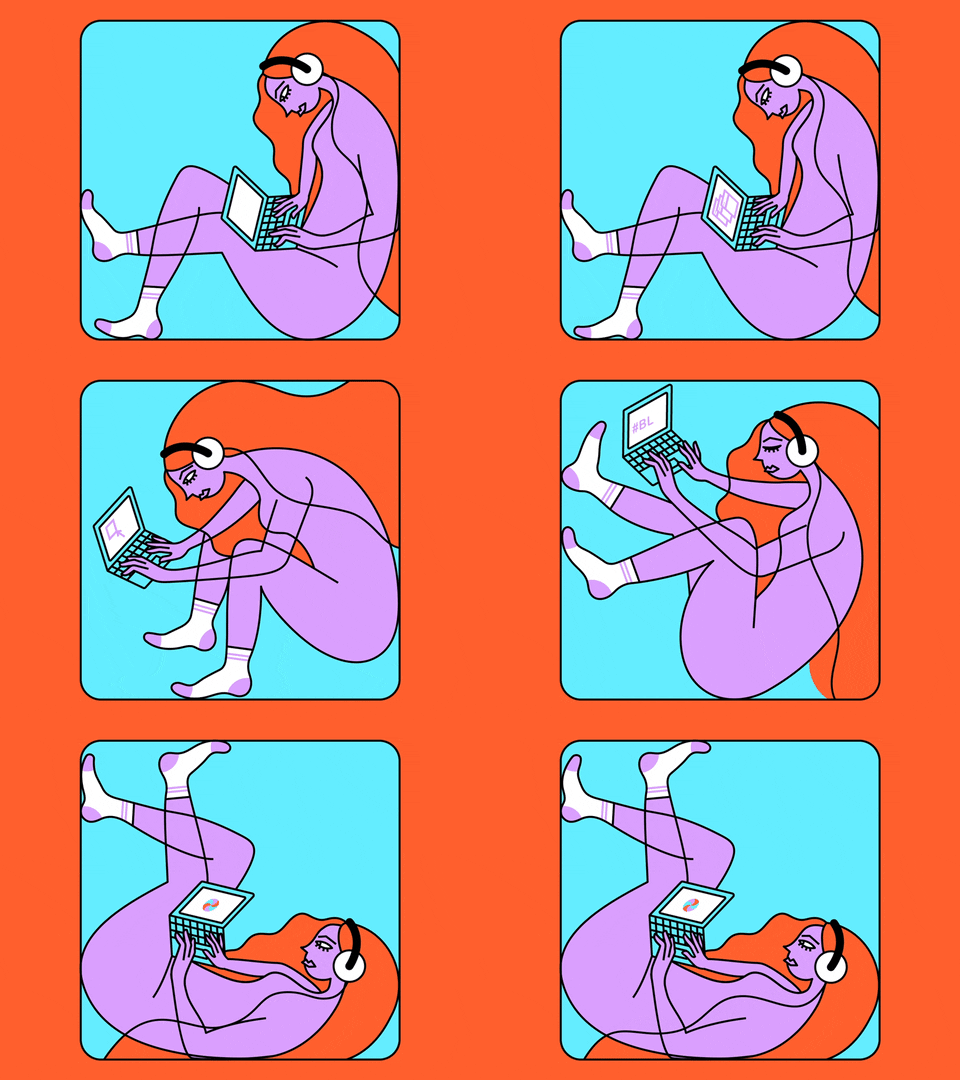
And then there’s the pain piece. People with pain missed approximately nine more days of work per year than respondents without pain, and chronic pain was associated with lower vocational fulfillment and feelings of being ostracized in the workplace. Chronic pain is lonely. It’s isolating. It tells you that you don’t belong, that your body is letting you down. nih
That’s not true.
What Actually Works—And Why You’re Worth the Investment
Decreasing estrogen is associated with loss of type II muscle fibers; resistance training during perimenopause is one of the most effective non-controversial prevention and treatment approaches for musculoskeletal symptoms.
This is not about aesthetics. This is not about “toning.” This is about reclaiming your infrastructure—the literal foundation that holds you up while you do your best work.
Three exercises. That’s it. You don’t need complicated. You need consistent.
Rowing (machine or barbell): This recruits your latissimus dorsi, trapezius, and erector spinae—the muscles that pull your shoulders back and open your chest. Start twice a week, 8 to 12 reps. Think about what it feels like to pull back, to make room for yourself. Your body will remember.
Deadlifts or trap-bar deadlifts: This one movement recruits nearly every muscle on your posterior side. Once a week is enough. And listen—form matters more than weight. I’d rather see you lift light with intention than heavy with your ego.
Farmer carries: Hold weight at your sides and walk. Five minutes. Twice a week. It’s that simple. Your grip gets stronger. Your upper back gets resilient. You remember what it feels like to carry something—literally and figuratively.
The Return on Your Investment
Within 8 to 12 weeks, something shifts. Your posture changes. Your pain baseline drops. And here’s the neuroscience: When bodies are held in a position of power, hormones react immediately—testosterone goes up and cortisol goes down—resulting in calm confidence.
That confidence? That’s not fake. That’s neurological. That’s real.
Long-term, here’s what you’re doing: you’re preventing the $3,000 to $15,000 per year in physical therapy costs that come in your 50s and 60s. You’re preventing the surgeries, the missed work, the slow fade of independence. You’re preventing a version of yourself that has to apologize for the space she takes up.
Prevention is always cheaper than repair. And you are worth preventing for.
This Is About Your Legacy
Your back carries you through everything—your career, your family, your life. When your back is strong, you stand differently. You negotiate differently. You claim space differently.
And the women around you? They see that. Your daughters see that. Your colleagues see that.
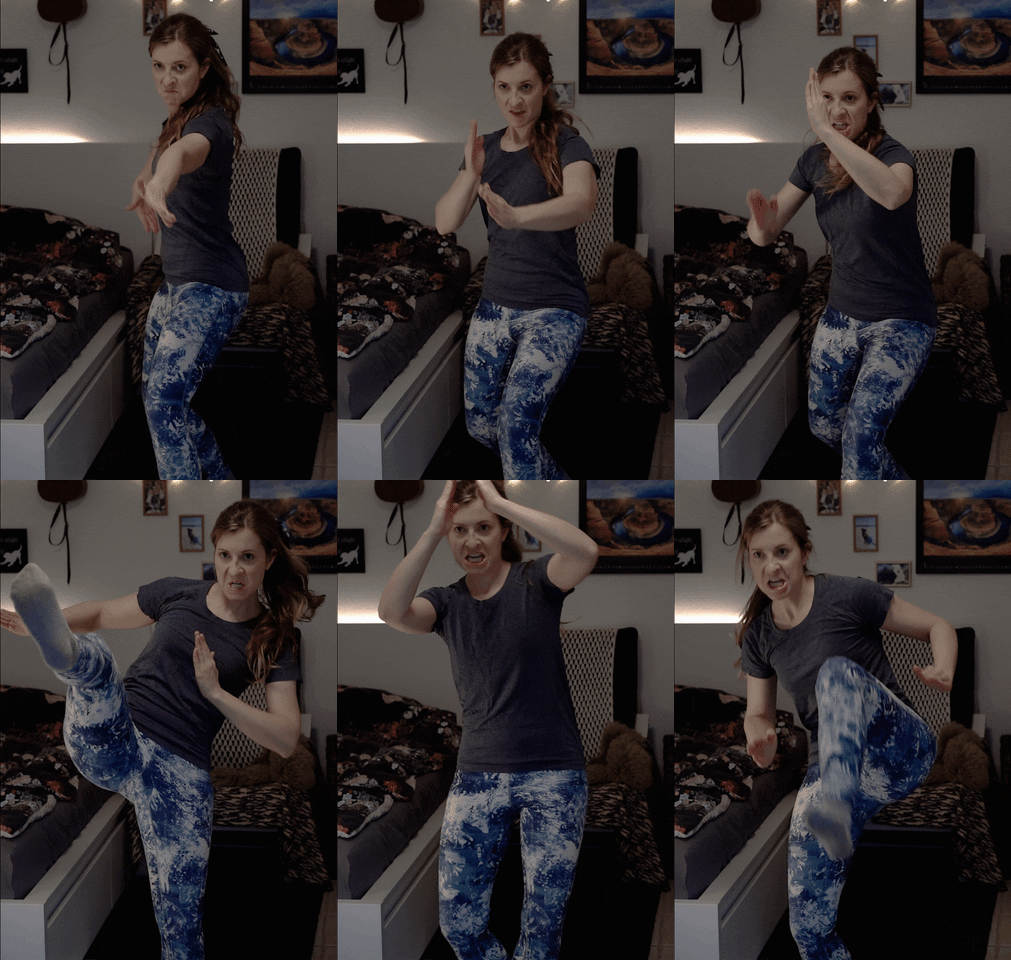
This isn’t vanity. This is dignity. This is saying: I am worth the effort. I am worth the fifteen minutes twice a week. I am worth taking up space.
So start this week. Pick one exercise. Commit to it. And feel your body remember what it means to be strong.
You deserve that.
Ready to Calculate the True Cost of Back Pain—and What You’re Actually Losing?
Your care costs are real. The physical therapy, the specialist visits, the days you’re managing pain instead of managing your life. But most women don’t know what number to put on it.
I built the Care Cost Workshop to show you exactly what perimenopause is costing you in healthcare—and more importantly, what you can do about it right now.
Join the Care Cost Workshop and get your number. Bring it with you everywhere. Because once you see it, you can’t unsee it. And once you can’t unsee it, you can change it.
Sources:
Menopause musculoskeletal syndrome, Taylor & Francis Online (2024): https://www.tandfonline.com/doi/full/10.1080/13697137.2024.2380363 Taylor & Francis Online
On-Site Massage corporate study (2024): https://onsitemassage.com/corporate-chair-massage/how-pain-affects-productivity/ Onsitemassage
Adams & Salomons on presenteeism and chronic pain (2021): https://www.ncbi.nlm.nih.gov/pmc/articles/PMC8210861/ nih
Thibault & Raz on posture and neural signaling (2016): https://pmc.ncbi.nlm.nih.gov/articles/PMC5073137/ PubMed Central
Wharton Knowledge: Power Posing research (2016): https://knowledge.wharton.upenn.edu/article/the-2-minute-power-pose-that-can-boost-your-performance/ Wharton School