

If you’ve found yourself Googling symptoms at 3 AM — heart racing, convinced something is seriously wrong — you are not losing your mind. You are not suddenly an anxious person. And you are not alone.
What you may be experiencing is health anxiety: one of the most exhausting, least-talked-about costs of the menopause transition. For high-performing women who have built careers on being sharp, decisive, and in control, this symptom hits differently. Because it doesn’t just affect how you feel. It affects how you lead.
Inside this issue:
Why perimenopause hijacks your nervous system (and why it’s not “just stress”)
Whether health anxiety is permanent — or has an expiration date
Four ways to protect your mental capital right now
The “Symptom of the Week” Cycle
Perimenopause has a way of keeping you off-balance.
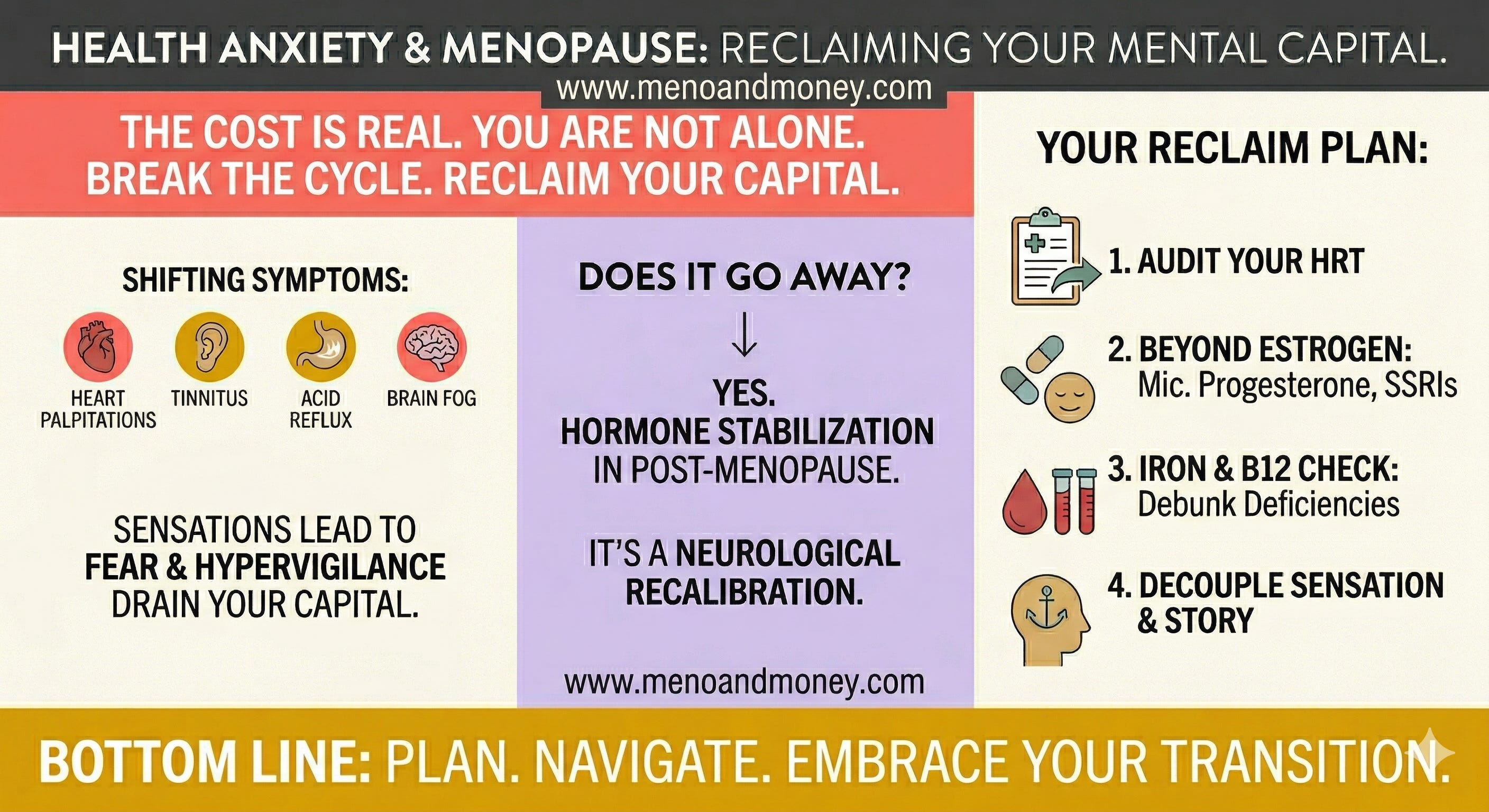
Heart palpitations one week. Tinnitus the next. Then the acid reflux, the brain fog, the strange heaviness in your chest that makes you wonder if this is something else entirely.
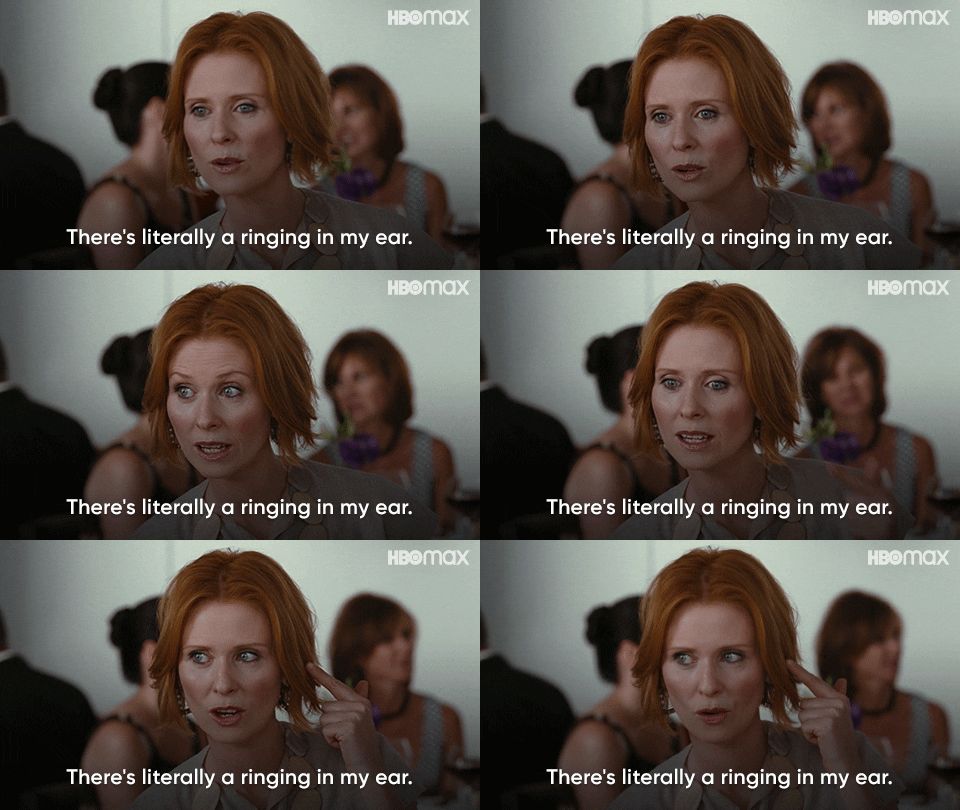
When your body starts feeling like an unreliable narrator, your mind works overtime trying to interpret every signal. That feedback loop — sensation leads to fear, fear leads to hypervigilance, hypervigilance makes every sensation louder — is its own kind of Menopause Tax.
Not the Care Costs you can see on an EOB. Not the Career Costs showing up in your performance review. This one drains something harder to quantify: your mental capital.
The Question Women Are Afraid to Ask
Does this anxiety ever actually go away? Or is this just who I am now?
It’s a fair question. And it deserves an honest answer.
For most women, the paralyzing “symptom of the week” phase does have an expiration date.
Many find that once they move into post-menopause, the hormonal spikes that trigger the alarm response level off. The intensity eases. One woman described feeling better in post-menopause than she had in years.
But here’s why it happens in the first place: declining estrogen disrupts your nervous system’s ability to regulate the stress response. Cortisol stays elevated — keeping your body in a low-grade state of alert even when nothing is actually wrong.
This is not weakness. It is not a personality shift. It is a neurological recalibration.
For some women, it resolves naturally once hormones stabilize. For others, the cycle needs to be interrupted more intentionally.
Four Ways to Protect Your Mental Capital
Anxiety isn’t just uncomfortable. For the Meno & Money woman, it is a direct drain on your most valuable professional asset: your focus.
1. Audit your HRT status. If you’ve been told you can’t take hormone replacement therapy, get a second opinion from a certified menopause specialist. Many old contraindications have been revised by modern research. Knowing what you’re medically entitled to is a core part of your Protection Plan.
2. Look beyond estrogen. Progesterone is sometimes called “nature’s Valium” — and for good reason. Micronized progesterone can have a calming effect on the nervous system. For some women, targeted SSRIs have also been the key to regaining clarity. This conversation is worth having with your provider.
3. Check your iron and B12. Heavy periods — extremely common in perimenopause — deplete ferritin and B12. Both deficiencies mimic anxiety and make it worse. A simple lab panel can tell you whether what you’re feeling has a nutritional driver.
4. Decouple the sensation from the story. This is what mindfulness actually means here — not candles and apps, but learning to notice a palpitation without immediately narrating a catastrophe around it. The sensation is real. The story your brain adds is often not.
The Bottom Line
You are not “anxious natured.” You are not fragile.
You are navigating one of the most significant biological transitions of your life — while still showing up fully in your career, your relationships, and your community.
But this phase is not permanent. And you do not have to white-knuckle your way through it alone.
Embrace the fact that your body is changing. Then let’s build a plan so that change doesn’t cost you any more than it already has.
How much of your mental capital has menopause already spent? Answer below.