


For decades, menopause was treated like a personal problem — something women managed quietly while the rest of life kept moving. That is starting to change. Across the country, states are passing laws that do what medicine and employers largely haven't: recognize perimenopause and menopause as legitimate health events that deserve coverage, protection, and resources.
As of early 2026, eight bills across multiple states have become law. Nineteen states have introduced legislation. The movement is bipartisan, and it is accelerating.
The States Leading the Way

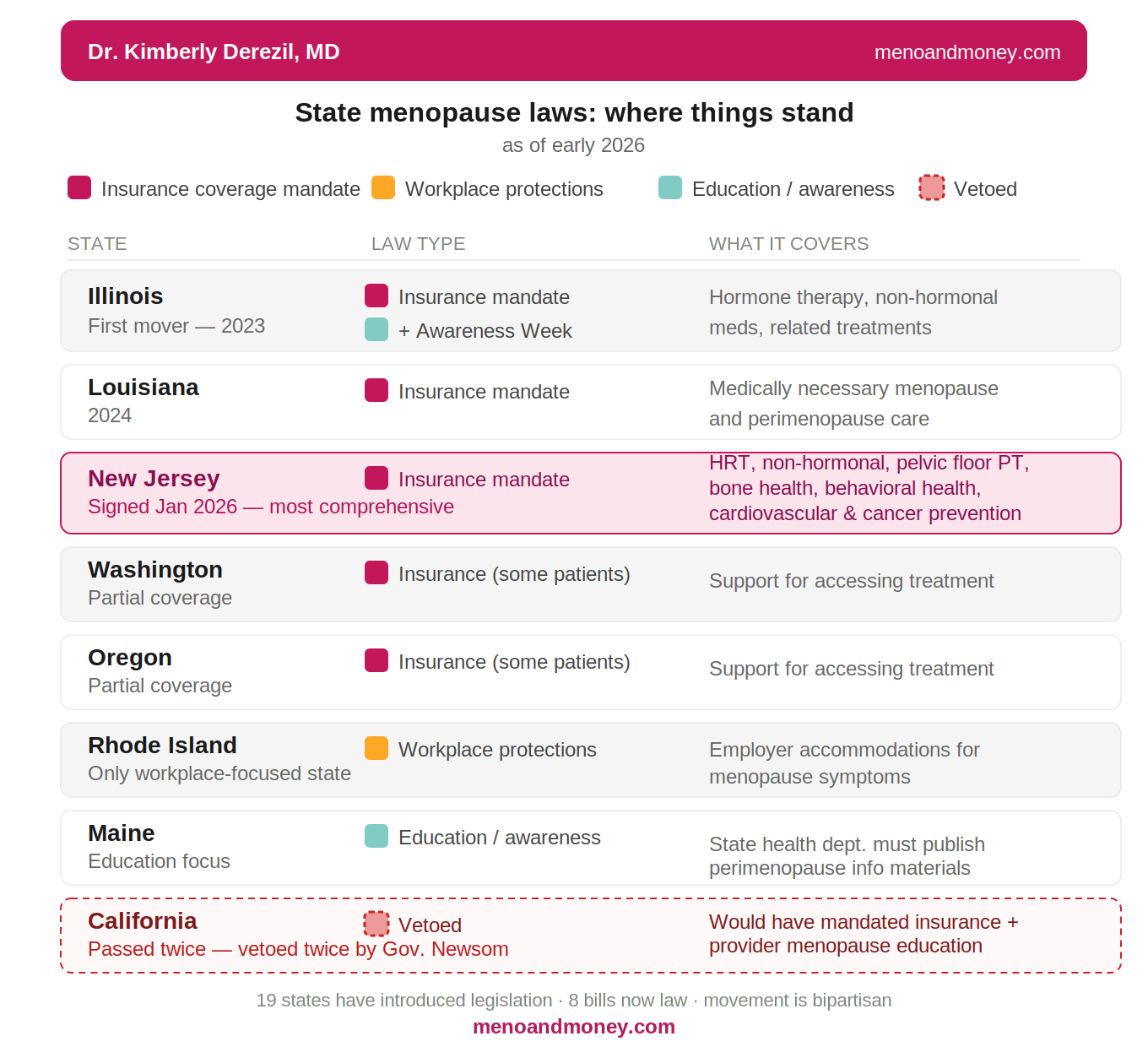
Illinois and Louisiana were the first to require mandatory insurance coverage for menopause treatments — Illinois in 2023, Louisiana in 2024. Both states now require health insurers to cover medically necessary care for menopause and perimenopause, including hormone therapy and related treatments.
New Jersey signed its Menopause Coverage Act into law in January 2026. It is one of the most comprehensive in the country, mandating coverage for hormonal and non-hormonal therapies, pelvic floor physical therapy, bone health screenings, behavioral health care, and preventative services for conditions like cardiovascular disease and osteoporosis. Insurers must also provide clear information to patients about what is covered — and treat menopause care at the same level as any other medical condition.
Washington and Oregon have passed measures supporting access to menopause treatment for at least some patients.
Rhode Island took a different angle, passing workplace protections for employees experiencing menopause symptoms — making it one of the first states to explicitly address what happens on the job.
California passed bipartisan menopause legislation twice. Both times, Governor Newsom vetoed it, citing cost concerns. He has since indicated he may include provisions in the state budget — but advocates warn that budget language is temporary and can disappear quietly.
Maine now requires its state Department of Health to develop and distribute educational materials on perimenopause and menopause. Illinois added a designated Menopause Awareness Week.
What These Laws Actually Cover
The most substantive laws — the insurance mandates — are requiring coverage for things women have been paying out of pocket for years: hormone replacement therapy, bioidentical hormones, non-hormonal medications, mental health care tied to menopause, pelvic floor therapy, and bone density screenings. States with workplace protections are requiring employers to offer reasonable accommodations for menopause symptoms, similar to what already exists for pregnancy.
The Gap That Remains
With the exception of Rhode Island, most of these laws don’t yet address is the workplace. Insurance coverage tells insurers what they must pay for. It says nothing about job protection, workplace accommodations, or what a woman is entitled to from her employer while she’s in the thick of it.
The result is a coverage map with real holes in it: women in 45 states have no insurance mandate, women in 49 states have no explicit workplace protection, and no law anywhere requires an employer to account for what perimenopause costs a woman professionally. That accounting remains entirely hers to do alone.
Does your state have a menopause law? If not — has that cost you anything?