


You stopped another medication. Again. Because your body told you something was wrong, and you listened. That’s not failure. That’s information.
But here’s the part nobody says out loud: going unmanaged through perimenopause isn’t free. It has a price. And it tends to collect quietly—in your paycheck, your retirement account, and the decisions you make on bad days.
You’re 49. You still have regular periods, so HRT feels like it’s “not for you.” The mini pill worked for the heavy bleeding but came with a tax you couldn’t keep paying—anxiety climbing, migraines worsening, your body fighting back. You’re done. That’s a reasonable choice.

The conflict isn’t whether to go medication-free. The conflict is going unprotected and uninformed at the same time.
Myth vs. Reality
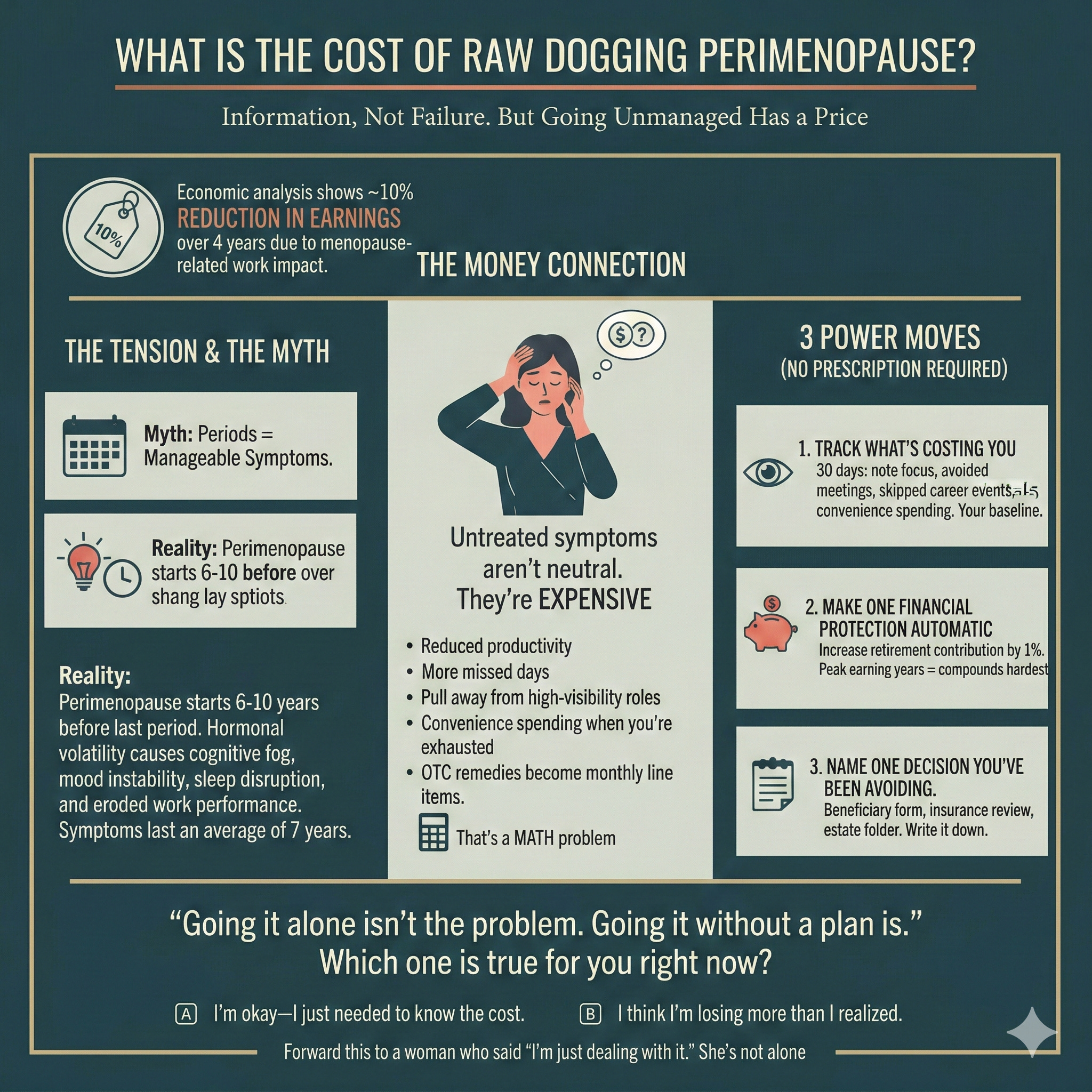
Myth: If you’re still bleeding regularly, you’re not in perimenopause and your symptoms are manageable without intervention.
Reality: Perimenopause can start 6 to 10 years before your last period. Regular cycles don’t protect you from the hormonal volatility that causes cognitive fog, mood instability, sleep disruption, and the slow erosion of your work performance. Symptoms that last an average of 7 years don’t wait for a convenient moment to cost you something.
Untreated symptoms aren’t neutral. They’re expensive.
The Money Connection
Here’s what the research shows—in plain language: women who experience significant menopause symptoms at work report reduced productivity, more missed days, and a measurable pull away from high-visibility roles. One economic analysis found that menopause-related workforce impacts can reduce earnings by roughly 10% over a four-year window. That’s not a mood problem. That’s a math problem.
Add the small daily costs—the convenience spending when you’re exhausted, the OTC remedies that become monthly line items, the mental load of managing symptoms alone—and “going it alone” has a real running tab.
This doesn’t mean you need to go back on medication. It means you deserve to know what you’re managing
.
Three Moves That Don’t Require a Prescription
Track what’s costing you. For 30 days, note the days you couldn’t focus, avoided a meeting, skipped something career-relevant, or spent money on convenience because you were depleted. You can’t protect what you can’t see. This is your baseline.
Make one financial protection automatic. If you have a retirement account contribution that isn’t maxed, increase it by even 1%. Perimenopause often lands in your peak earning years—this is when that money compounds hardest. Set it and don’t revisit it tonight.

Name one decision you’ve been avoiding. Beneficiary form, insurance review, estate folder you closed six months ago. Pick one. Not to solve it—just to write it on a sticky note. Future you will find it on a clearer day.
“Going it alone isn’t the problem. Going it without a plan is.”
Which one is true for you right now?
A) I’m okay—I just needed to know the cost
B) I think I’m losing more than I realized
Forward this to a woman who said “I’m just dealing with it.” She’s not alone—and she doesn’t have to absorb the whole cost in silence.
You don’t have to solve this tonight. But you should know what’s at stake.