

On April 25, I was in a room with the TheTruthBeToldCollective talking about something we don’t talk about nearly enough: money and health. And I mean really talking about it—not the Instagram wellness version, not the generic financial advice you get from someone who’s never sat in a doctor’s office worried about a bill.
I was there as Executive Director of Women’s Health, speaking with motivated individuals who showed up because they knew something was off. And something is off. We live in a system where your body’s needs and your bank account are treated like two completely separate problems. They’re not. They’re the same problem. And until we start talking about them that way, we’re all just limping along pretending it’s normal.
The questions people asked that day told me everything. They weren’t asking for inspiration or motivation. They were asking for information. They were asking what to actually do. And I could tell—by the way they leaned in, the way they took notes—that nobody had ever given them straight answers before.
That matters. So let me give you the same straight answers.
THE MONEY QUESTIONS EVERYONE NEEDS TO ASK
“What can I do to lower my medication costs right now?”
Here’s the thing: we act like drug prices are written in stone. They’re not. The system just counts on you not asking.

So ask.
Check GoodRx or Cost Plus Drugs before you go to your pharmacy. Mark Cuban built a pharmacy that sells generics at cost plus 15 percent. No insurance needed. One quick search can cut your prescription bill in half. I’m not exaggerating. One search.
Ask for 90 days instead of 30. Your doctor can write it on the prescription. The cost per pill drops. Do it.
If a medication is still too expensive, go to NeedyMeds.org. Drug manufacturers have patient assistance programs. Free medications. Life-changing ones. Most women I know have never heard of this site. Most never will. But you will. You’re reading this right now.
Why am I telling you this? Because during the years you’re going through perimenopause, you’re probably taking four prescriptions. Hormone therapy. Sleep medication. Maybe an antidepressant because nobody told your doctor it was actually brain fog. The bills add up fast. But knowing these four moves? That’s $1,500+ back in your pocket every single year. That’s real money. That’s your money.
RESOURCES THAT ALREADY EXIST—THEY’RE JUST HIDING
“What do you wish people in New Jersey knew about coverage and care?”
I’m going to be direct with you: the state has money and programs sitting on the table. Most people never touch them because nobody tells them the programs exist.
Let me tell you.
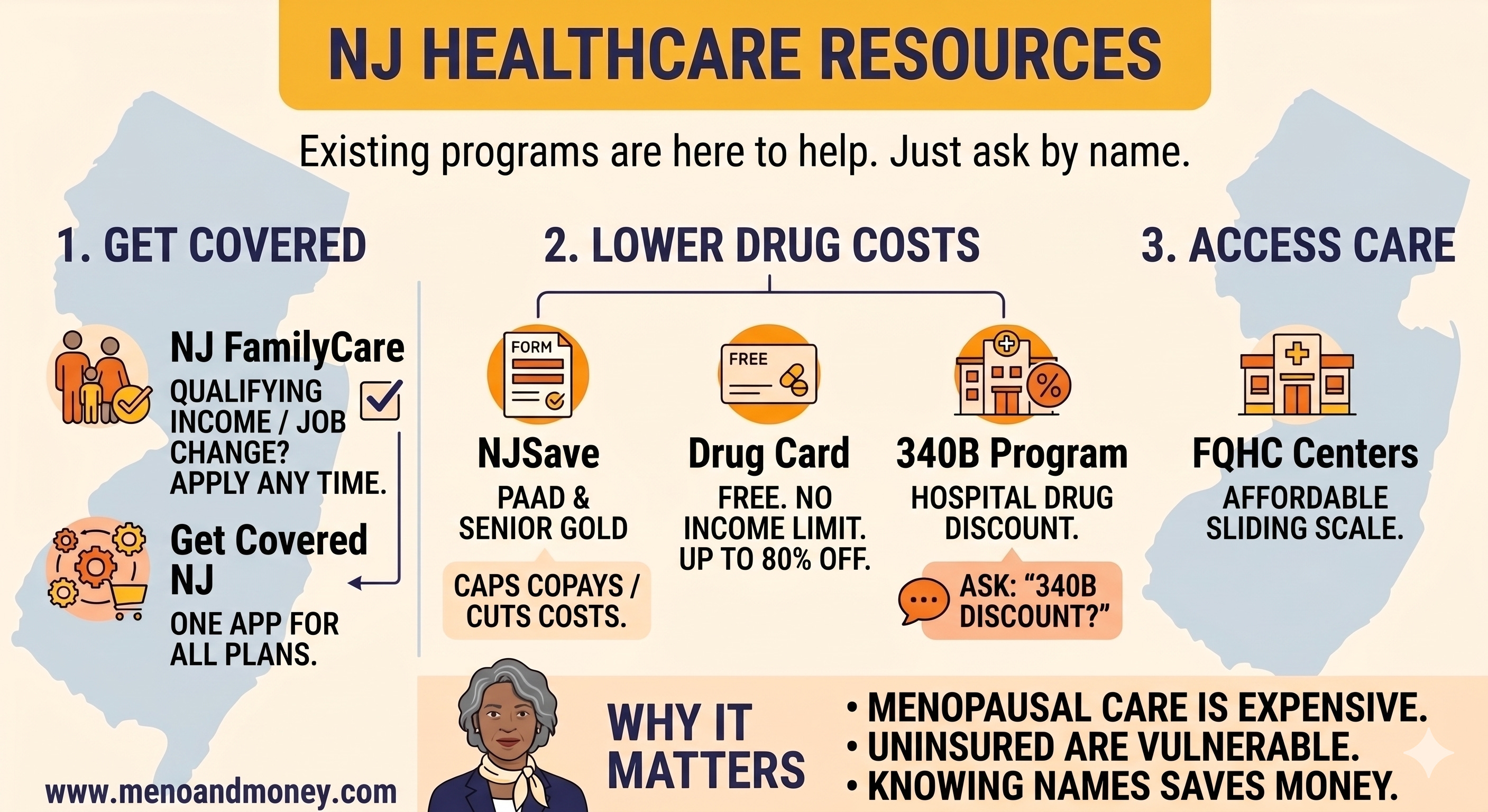
First, get covered:
NJ FamilyCare is Medicaid. If your income qualifies, you can apply any time. You don’t have to wait for open enrollment. You lost your job? Your hours got cut? Those are reasons to apply right now.
Get Covered NJ is the state marketplace. Qualifying life events—a move, a job change, a shift in income—open the door outside the normal season. One application screens you for both marketplace plans and Medicaid at the same time. You fill it out once.
Then, lower what you’re paying:
NJSave: One form. It checks you for PAAD and Senior Gold in one step. PAAD caps your copay at $5 for generic, $7 for brand-name. Senior Gold kicks in if your income is too high for PAAD—and after a $15 copay, it cuts your remaining drug costs in half.
The NJ Drug Card: Free. No income limit. No insurance required. Up to 80 percent off. You don’t even apply. You just print it and use it.
The 340B program: Federal law says hospitals that serve low-income patients get a 25 to 50 percent discount on drugs. But here’s the catch: research found that some pharmacies don’t automatically pass that discount to uninsured patients. So you have to ask. Ask directly: “Does your pharmacy participate in 340B, and does that discount apply to uninsured patients?” Those two questions either open the door or tell you to find a different pharmacy.
For care itself:
Federally Qualified Health Centers charge based on what you earn. Some visits cost $20. Find the one closest to you.
Nobody hands you this list. The system doesn’t care if you know about it. You have to ask for it by name.
Here’s why this matters: perimenopausal women face some of the highest healthcare costs of their working lives. Diagnostic tests. Specialist after specialist. Trial and error treatment after treatment. If you’re uninsured or underinsured, that cost wall can force you to skip care entirely. And you can’t skip care when your body is changing this fast. Knowing these programs—these exact names, these exact places—is the difference between your family paying out of pocket and paying next to nothing.
THE ONE THING THAT ACTUALLY CHANGES HOW YOU’RE TREATED
Ask questions.
Here’s what I told them: you’ll get more out of asking questions than I’ll get out of asking you questions. Ask about cost. Ask about timing. Ask about alternatives. Ask about your life.
Most people walk in waiting for the doctor to ask the right questions. But we can’t read your mind. Ask.
We’re taught these questions are impolite. They’re not. You’re making a financial decision every time you interact with healthcare. So ask about it.
Most people assume the price is fixed. Sometimes it is. Most assume asking makes them look difficult. It doesn’t. It makes them look smart.
Women who ask these questions get better care. Faster answers. They stop spinning their wheels on unnecessary tests.
This matters for menopause because misdiagnosed perimenopause creates a cascade—cardiac workups, neurological tests, GI workups. One woman can spend $65,000 on unnecessary tests before someone identifies perimenopause. But if you ask the right questions from the start? You interrupt that spiral before it starts.
HOW TO ACTUALLY GET HEARD IN A DOCTOR’S OFFICE
“How do you effectively advocate for yourself?”
If something doesn’t feel right, get a second opinion.

That’s it. Don’t apologize for it. Don’t worry about your doctor’s feelings. You’re the one living in your body. You’re the one paying the bills.
I’m a doctor. And I’m telling you: we can be wrong. We can miss things. We can also have an off day, not listen carefully enough, or dismiss your concerns.
If you walk out of an appointment feeling unheard or confused—if something doesn’t sit right—get another perspective. Trust your gut.
Perimenopause symptoms hide. Brain fog looks like ADHD. Night sweats look like thyroid problems. Sleep disruption looks like depression. One doctor might miss it. Another sees it immediately.
Find the doctor who listens. Find the one who takes you seriously. That’s not unreasonable. That’s taking care of yourself.
THE REAL WORK
You can find a good doctor. You can find a good financial advisor.
Most healthcare conversations happen in one lane. Medicine on one side. Money on the other. And women are left to figure out how to connect them ourselves.
That’s exhausting.
That’s what the Care Cost Workshop is for. It’s where we do this work together. Not in theory. Not in isolation. But with real numbers, real questions, and real answers.
In 90 minutes, you’ll walk through exactly what’s actually costing you during this transition. You’ll understand the Care Costs—what you’re paying right now, today. You’ll identify where the money is going and where it could stop going. You’ll leave knowing your number. Not a guess. Not a range. Your actual number.
Because once you see it, you can change it.