


Starting this fall, it does. Apple announced in June that the next iPhone update adds perimenopause and menopause to the Health app.
So let me ask the better question. Why did it take until 2026?
The cycle tracker has been on your phone since 2019. For seven years, it gave you three reasons your period might change. Birth control. Pregnancy. Breastfeeding. That was the whole list.
There is a reason for that. Two reasons, actually. And the second one is the one I want you to sit with, because it is the one that touches your wallet.
THE APP WAS BUILT FOR YOUNGER WOMEN
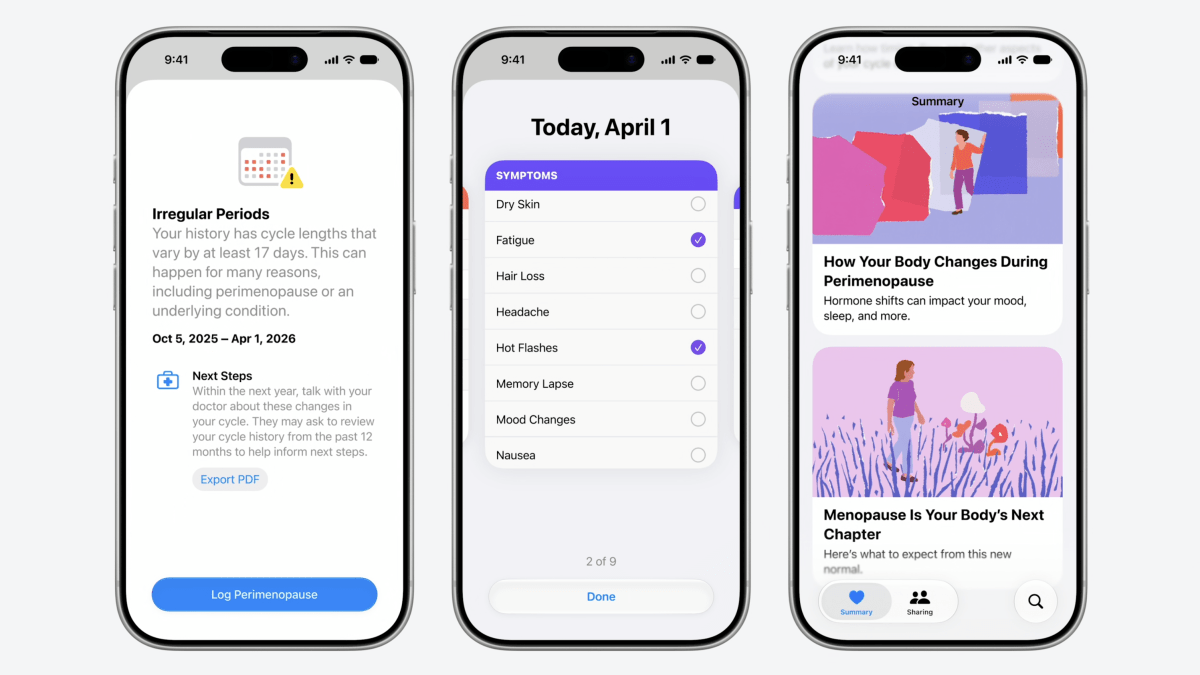
Think about those three options for a second. Each one starts on a day you can name. Each one changes your body in a way a computer can predict. And each one is really asking you the same thing: are you trying to have a baby, or trying not to?
That is what the tool was for. So picture a woman at 47 whose period shows up every 24 days now instead of every 28. The app has no place to put that. It just asks if she forgot to log something. Her body is changing, and the software treats it like she made a mistake.
Now, there is a real medical problem here too, and I want to be fair about it.
There is no blood test for perimenopause. None. Your hormone levels bounce around during this time, sometimes inside a single month. A test can look normal one week and look different the next. That is why the major medical groups tell doctors to diagnose women over 45 by looking at their periods and their symptoms, and to skip the lab work.
Doctors use a set of rules for this. One of the first signs of perimenopause is when your cycles start landing a week or more apart from each other, and it keeps happening.
So think about what that means. The changing pattern is the diagnosis. There is no morning you wake up and know to check a box, because the box and the proof are the same thing.
That is why Apple built something smarter. The app now watches your cycles over time and tells you when the pattern looks like perimenopause. Honestly, that is a good design. My question is why we waited seven years for it.
THE MONEY WENT WHERE THE MONEY WAS
The medical problem explains what the feature looks like. It does not explain the seven years. For that, you have to look at who was paying.
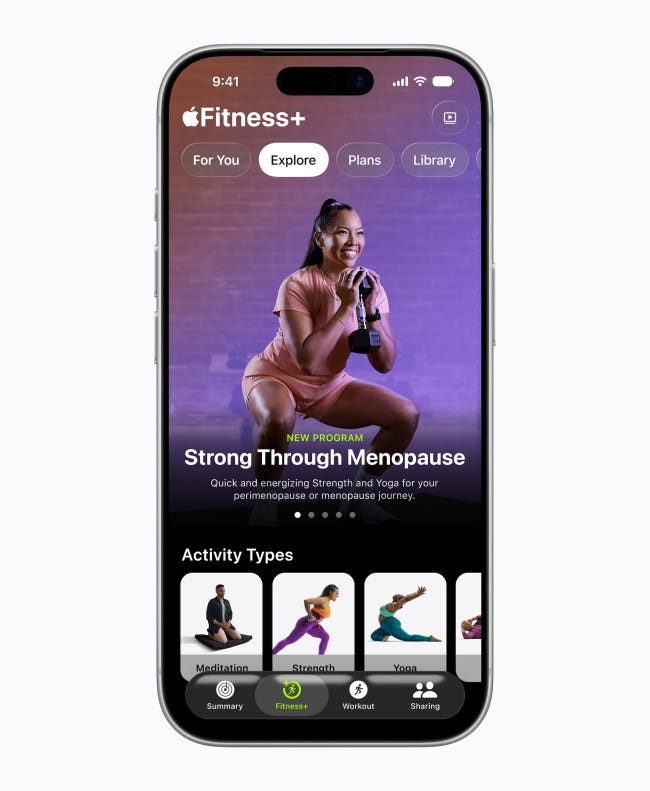
Fertility apps had customers from the beginning. Women trying to get pregnant will open an app every single day, and companies could sell to that. Menopause had no buyer like that, so nobody built for it.
Then the money showed up. Bloomberg just put the menopause treatment market at $19 billion.
I want to be plain about this. Apple always knew what perimenopause was. What changed is that the market got big enough to be worth their time.
HERE IS WHY THIS MATTERS TO YOU
That missing word costs you real money. Let me show you how.
Evernorth looked at the medical records of 1.5 million insured women between 40 and 64. More than half had symptoms of perimenopause or menopause. Only eight percent had it written down as a diagnosis.
Say your periods start coming closer together and heavier. Your app asks if you are pregnant. So you see your doctor about the bleeding, and you get an ultrasound, a thyroid panel, an iron test, and a referral. Fourteen months pass before anyone says perimenopause out loud.
You paid for all of it. That is the Care Costs part of the Menopause Tax™, and it started because nobody named what was happening.
Your paycheck pays next. In a Mayo Clinic study of 4,440 working women ages 45 to 60, 13 percent missed work, cut hours, turned down work, retired early, or lost a job over their symptoms. Nationally that is $1.8 billion in lost work time a year, and $26.6 billion once you add the medical bills.
Cut hours means less going into your retirement account and a smaller match from your employer. It also shrinks your Social Security record, and that number follows you for life. Nobody bills you for that one. You just get less at 67.
That is why a decision inside a phone app belongs in a conversation about money. For seven years, the health tracker in millions of pockets had no place to write down what was happening to women in their forties. And what is never written down never gets treated, never gets covered, and never shows up as a number you can take to your employer.
The update helps women who own iPhones and log their cycles faithfully. It does nothing for the woman who was told her sore joints were arthritis, or her racing heart was anxiety, or her heavy bleeding needed one more scan before anyone would say the real word.
So here is my question for the benefits leaders reading this. Your own claims data almost certainly looks like that Evernorth number. What is your plan doing about all the years that come first?
And if you are the woman in this story and you want to know what the delay already cost you, that is a conversation worth having one on one. Book the Meno & Money™ Audit at menoandmoney.com.
Dr. Kim Derezil | MD | WMCP® | Founder, Meno & Money™
Sources
Apple, WWDC 2026 announcement, June 8, 2026, iOS 27 Health app updates.
Harlow SD, et al. STRAW+10 staging criteria for reproductive aging. Menopause, 2012.
ACOG, NICE guideline NG23, and The Menopause Society guidance on symptom-based diagnosis of perimenopause in women over 45.
Bloomberg Big Take, “The $19 Billion Menopause Economy,” August 5, 2026.
Evernorth Research Institute, analysis of 1.5 million commercially insured women ages 40 to 64.
Faubion SS, et al. “Impact of Menopause Symptoms on Women in the Workplace.” Mayo Clinic Proceedings, 2023. PMID 37115119.
Eight percent documented against more than half symptomatic says the gap Apple Health just inherited was already sitting in the charts. A cycle-tracking category in the app doesn't move that number much if clinicians still aren't writing perimenopause into the note itself