


My client had been working in her glass-walled, ergonomically designed office, overlooking the city, for 25 years. And then the unthinkable happened. One day, she just stopped being able to control her body temperature — not figuratively — literally. Now, at age 52 and perimenopausal, she can’t stay cool in her company’s 72-degree “optimal productivity” temperature-controlled space. During meetings, she is constantly fanning herself and has lost focus and her train of thought. This former senior counsel, who once negotiated million-dollar deals at age 45, now believes she should sell all of her stock holdings and move them into cash. She thinks she is no longer able to make good judgments.
As her physician, I recognized that she was suffering from thermoregulatory dysfunction. As a financial advisor, I also recognized that there are millions of dollars in decision-making debt that she will never be able to recoup. She is not broken. The interface with her workplace is broken.
The $340 Million Design Failure
This is what I call the Physiological User Experience (PUX)™ — the conflict between fluctuating hormones and the workplace environment. Hot flashes alone are estimated to cost American businesses $340 million annually. Twenty percent of professional women have either already left their job or are considering leaving their job because of menopause related symptoms — not because they lack ambition, but because of the failure of the workplace design. We have spent over twenty years designing workplaces for the best possible user — the 23-year-old male with stable hormones. All other users have to adapt, layer, and suffer silently until menopause, when the design fails.
I experience this from both sides. In the exam room, 54% of patients report fatigue; 47% report disrupted sleep; 44% report reduced ability to concentrate; and 40% report impaired memory. In strategy sessions: $6,000 per year in productivity loss per perimenopausal woman; delayed career advancement; and, for some, cash-out decisions which result in a $1.2 million reduction in lifetime retirement savings. The same failure, different mask.
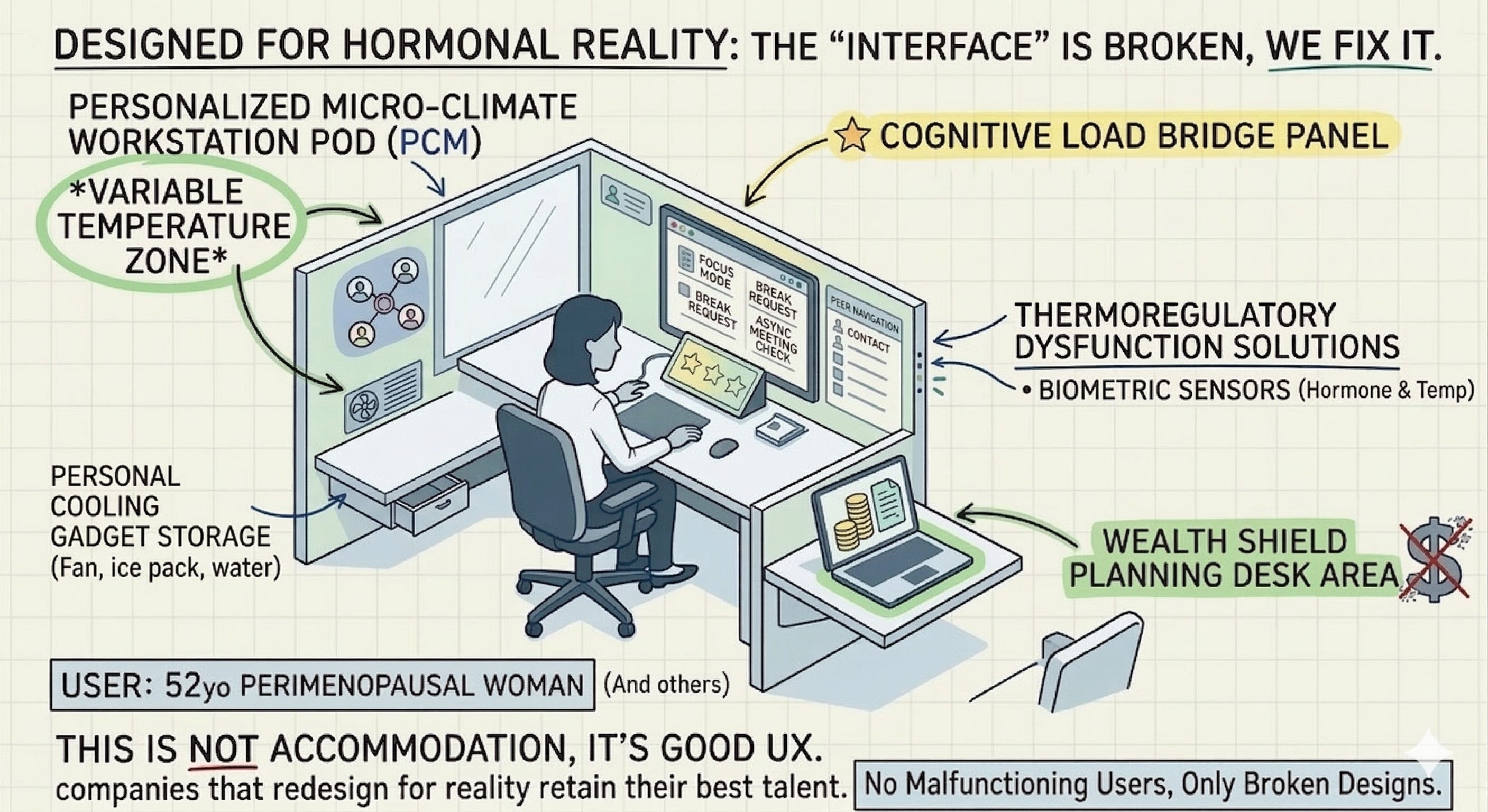
Thermal Dysregulation as Cognitive Sabotage
There is no debate about the data. Perimenopausal women need an average temperature of 2 degrees Celsius lower than their postmenopausal counterparts to maintain proper thermoregulation. Your optimal 72 degrees causes hot flashes in 20% of your workforce at any given time. When a hot flash occurs, cortisol levels spike, causing significant impairment to verbal memory and processing speed for hours. Your high-productivity temperature literally reduces the IQ of your most intelligent employees.
We do not talk about this. Instead, we refer to it as “brain fog,” and conclude that competence is declining. What I see clinically: four hours of sleep, hypothalamus firing erratically during board meetings. Then the financial consequences occur: the 401(k) account is moved to cash “when this passes,” promotions are delayed because she “cannot handle more,” new initiatives are canceled prior to failure because she cannot manage another variable.
Decision Making Debt and the Wealth Erosion Spiral
This is decision-making debt. Every hour of every day, your innovative workplace creates decision-making debt for peak-career women experiencing hormonal compromise.
Women experiencing hormonal imbalance during their peak career years do not seek accommodations. They do not disclose. They quietly sabotage themselves. As a financial planner, I recognize this pattern: sudden conservative allocations; postponed home purchases; “wait and see” approaches that eliminate compound returns. As a physician, I address the physiology: hormone replacement therapy, sleep interventions, and symptom management. I cannot redesign the office architecture. Someone needs to intervene upstream.
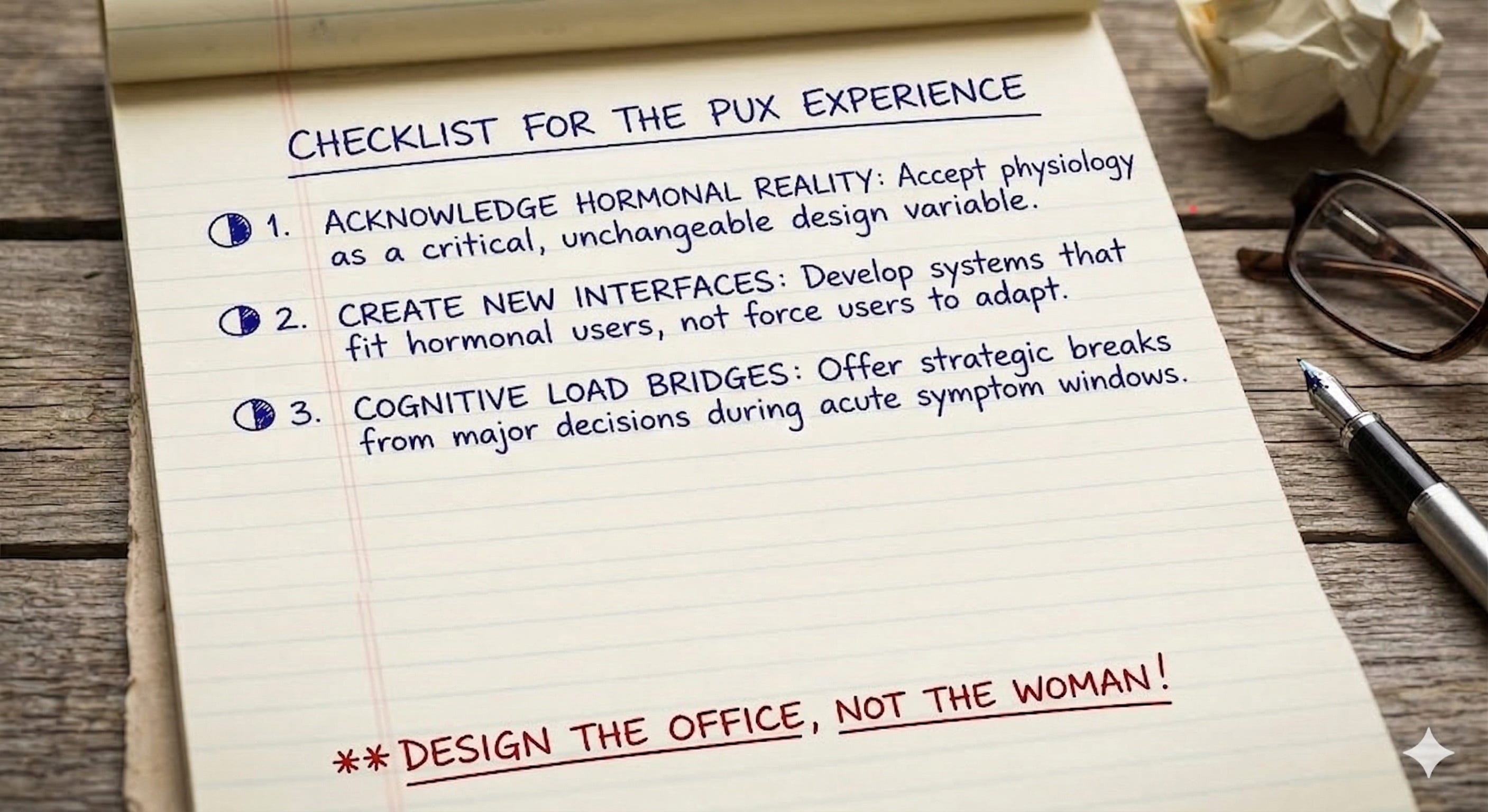
Designing New Interfaces
Companies leading the way in addressing the hormonal challenges of menopause are not offering menopause-related benefits. They are creating new interfaces. Microsoft, Citigroup, and Unilever provide access to specialized healthcare, flexible scheduling, and environmental control. The next generation of innovators is taking it further: developing cognitive load bridges — strategic breaks from major decisions during acute symptom windows; providing managers with education on recognizing decision-making debt rather than performance decline; and establishing peer navigation networks for women who have successfully navigated this transition to recognize signals in others.
They treat menopause as a design problem, not a woman’s issue. Which it is.
Your open office with collaborative vibes and fixed thermostat? Design theater, not innovation. True innovation requires variable temperature zones that go beyond the gimmick of hot desks; meeting formats that take into consideration cognitive load — shorter sessions, asynchronous options, permission to turn off the camera when hot flashes strike; and, financial planning that asks about hot flashes, not simply risk tolerance.
The woman sitting in the corner office, frozen with fear, is not malfunctioning. Your design is. She is contemplating quitting — or remaining and making conservative investment decisions that will cost her six-figures in lifetime wealth — because you designed a workplace for a non-existent user.
Designing for Hormonal Reality
Menopause is not a health crisis. It is a design revelation. It exposes how little we truly understand about the humans that occupy our spaces. From my perspective as someone treating symptoms and calculating costs, I know: companies that redesign for hormonal reality instead of fantasy will not only retain women. They will create workplaces that function.
This is soooo good!! Thank you for compiling and sharing all of this! So helpful!