


A Note Before You Read: The clinical guidance referenced in this article was published by the British Menopause Society (BMS) in April 2025. No equivalent guideline currently exists in the United States. I am sharing it because my community should not have to wait.
Your Doctor May Not Know This Yet
In April 2025, the British Menopause Society released an urgent clinical tool for thier physicians. It addresses a question that millions of American women are living right now — and that US guidelines have not yet answered:
“What happens to your HRT when you’re also on a weight loss shot?”
The short answer: your HRT may not be working the way you think it is.

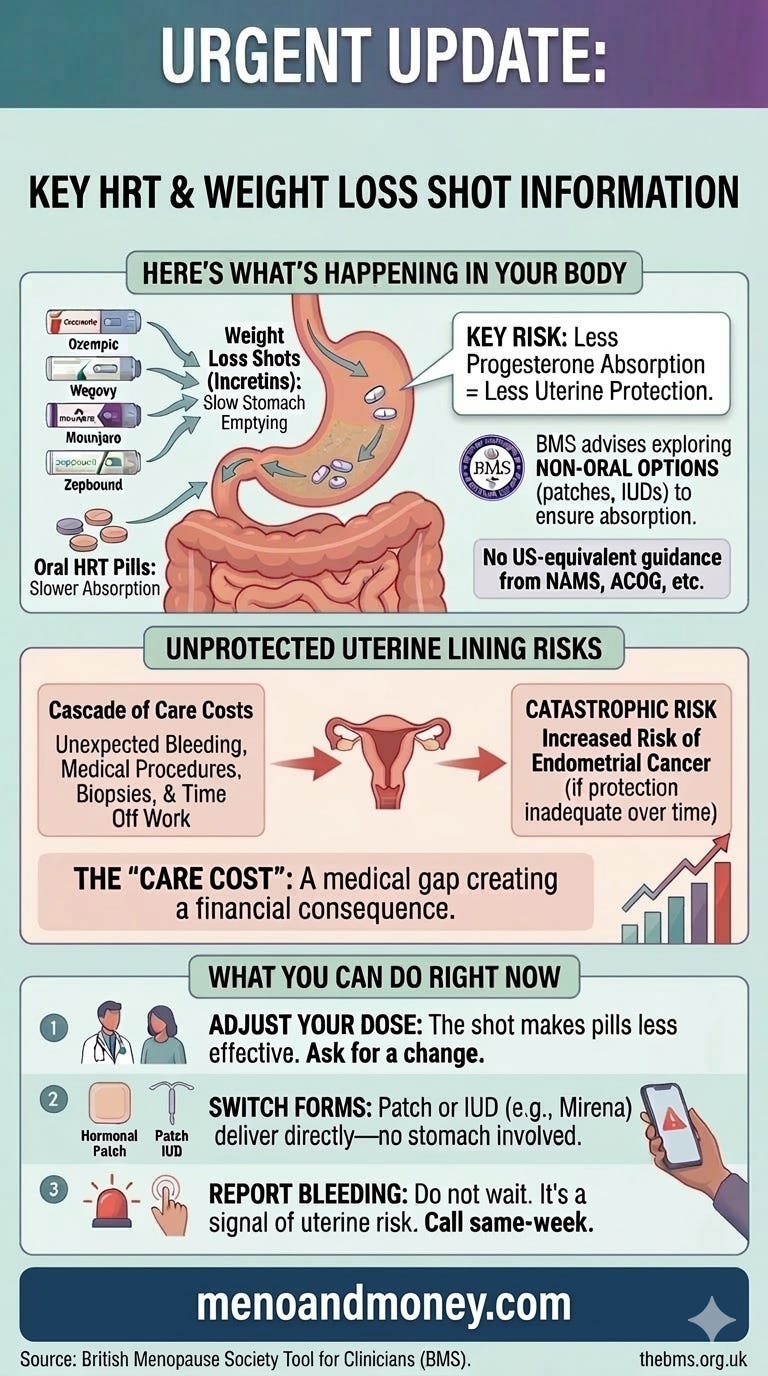
Here’s What’s Happening in Your Body
Medications like Ozempic, Wegovy, Mounjaro, and Zepbound slow down your stomach. That’s part of how they work — slowing digestion reduces appetite and controls blood sugar.

But that same slowing affects how your body absorbs oral medications — including the pills in your HRT.
The part most at risk? Progesterone. That’s the hormone that protects your uterine lining. If it’s not absorbing fully, your uterus may not be protected the way your prescription assumes.
The BMS guideline now formally advises physicians to consider this risk and to explore non-oral options — like a patch or a hormonal IUD — when a patient is on both therapies at the same time.
No equivalent guidance has been issued by any US body. Not NAMS. Not ACOG. Not the Endocrine Society.
This Is the Menopause Tax in Real Time
When progesterone doesn’t absorb properly, the consequences don’t stay clinical. They become financial.
Unexpected bleeding triggers a cascade: urgent appointments, pelvic ultrasounds, possible biopsies, time off work, and real fear. In high-risk women — those with obesity, diabetes, or elevated estrogen exposure — inadequate progesterone protection over time increases the risk of endometrial cancer. That cost is catastrophic.
This is what I call a Care Cost: a medical gap that creates a financial consequence. Hidden. Compounding. Preventable — if you know about it.
What You Can Do Right Now
1. Ask your doctor if your progesterone dose needs to be adjusted. If you’re taking progesterone as a pill and you’re also on a weight loss shot, the dose you were prescribed may no longer be enough. The shot slows your stomach, which means less of the pill is getting into your system. Ask: “Do I need a higher dose or a different form while I’m on this medication?”
2. Ask about switching to a non-pill option. A hormonal IUD like Mirena or a combination patch delivers progesterone directly — no stomach involved, no absorption problem. These options exist and they work regardless of what your weight loss shot is doing. Ask if one is right for you.
3. Do not ignore unexpected bleeding. Bleeding when you shouldn’t be is not something to monitor at home. It is a signal that your uterine lining may not be protected. Call your doctor the same week it happens.
My job is to give you the medical and financial picture together — before the gap costs you. This is one of those moments.
Source: British Menopause Society Tool for Clinicians — Use of Incretin-Based Therapies in Women Using HRT. Published April 2025. thebms.org.uk
I just signed up for your newsletter after seeing you at Uplifters. Thank you for this life saving information! Put a call into my doctor.